


Private Correctional Services in Dow Jones: Prison/Security Industries |
||||||
| Rank | Company | Sales (m) | Employees | Market Cap (m) | Net Income (m) | Net Profit Margin |
| 4 | Corrections Corp. of America | 1,759.89 | 17,000 | 3,825.79 | 157.12 | 8.93% |
| 5 | GEO Group, Inc. | 1,479.06 | 18,733 | 2,503.00 | 145.41 | 9.83% |
| 6 | Taiwan Shin Kong Security Co. Ltd. | 233.66 | 7,385 | 469.51 | 33.02 | 14.13% |
| 7 | Command Security Corp. | 150.22 | 5,500 | 13.37 | 0.5 | 0.33% |
| 8 | Tri-S Security Corporation | 141.33 | 2,600 | 0 | 0 | 0.00% |
| 9 | Japan Reliance Service Corp. | 66.51 | 394 | 9.52 | 1.07 | 1.61% |
| 10 | Solar Enertech Corp. | 42.69 | 290 | 0.93 | -1.69 | -3.96% |
| 11 | Avalon Correctional Services Inc. | 22.9 | 385 | 0 | 0 | 0.00% |
| 12 | Traqueur SA | 22.03 | 74 | 8.66 | -0.52 | -2.35% |
| 13 | Croma Security Solutions Group Plc | 15.55 | 326 | 4.1 | -0.66 | -4.22% |
Since that time, the prison "industry" has flourished. Like the 1950s military establishment and all its propaganda growing parallel to the complimentary need for military employment and profit, the penal system has encouraged policy makers to "get tougher," creating a lucrative niche market for criminal justice stakeholders profiting from increased convictions. Highlighting the intimacy between correctional interest groups and policy-makers, Nils Christie described the strategies of the California prison guards' association in giving millions of dollars to government leaders responsible for expanding the prison industry, resulting in the lobbying tactics that paved the way for the now famous "three strikes and you're out" law. The advance of prison privatization and so-called "warehousing" remerging from its Civil-war-era past in the 1980s follows from the profound increases in offender populations, and the subsequent increases in prison maintenance costs coupled with increased budgetary constraints.
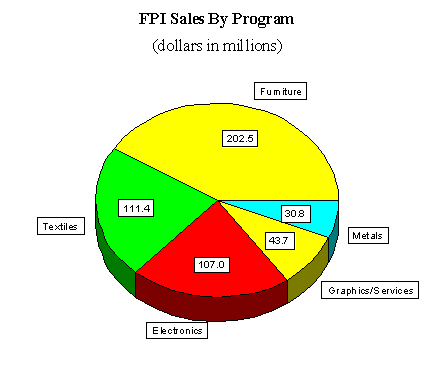
Currently, the largest employer of convicts in the United States is Federal Prison Industries (Unicor), with 18,000 prisoners making some 150 products, including safety goggles, air force jet wiring, body armour and road signs. See the pie chart to the left for a breakdown of tax-free revenues earned by the federal government due to the proceeds from offender labor. Combined with the nation's entire fleet of private prison industries, the number of convict labourers across the country reaches 72,000. Unicor's products are considered poor quality, and consistently inferior to the private sector's products. They cost more to make, have higher defaults, and take longer to procure (Parenti 1999), even in Texas, where prisoners do not even get paid to work. Part of this is because Correctional Officers often feel in danger and unable to control inmate labour, fearing homemade tools will be fashioned into weapons and used against them. As a result, resource-heavy frisks, searchers, supervision, and pat-downs become commonplace. There is also, of course, the lawsuits, which can deter private businesses from investing in prison labour.

One historic instance of prisoners running a mutiny occurred in February of 1924. License-plate production at the state prison backfired on the state government when convicts inside Ohio State Penitentiary began secretly conducting a license-plate manufacturing and distribution scheme, smuggling duplicate plates out of prison to recently paroled accomplices. The practice lasted two weeks. Such incidents today are rare occurrences, if not unheard of, much to the satisfaction of correctional departments. For prison labour to function properly, it must gain majority consent from the public, and with the otherwise state-stigmatizing media reports such as these failing to threaten the infrastructure upon which the Auburn ideology rests, we can say that prison labour has gained that majority consent.
The American Civil Liberties Union (ACLU) has often criticized private prison industries out of fear that they erode inmates' due process rights. In 1984, the NSA adopted a policy opposing for-profit jails and in 1986 the American Bar Association (ABA) announced a moratorium on private prisons until the complex ethical and constitutional issues could be properly resolved. At the same time, however, private investors, members of the public, and the American Correctional Association, itself, generally endorse the use of prison privatization as a way to reduce taxpayer costs and improve the efficiency of offender administration. This is despite the fact that several key divisive issues remain to be resolved before prison privatization truly gains popular consent. Among these are the following, as identified by Logan (1990):
In gaining consent among the public for prison labour, state-sponsored correctional organizations promote their products to gain public consent, such as the promotion of convict-made license plates, as touted by Utah Correctional Industries: http://uci.utah.gov/licenseplates, that attempt to legitimize the apparently oppressive character of prison work. Instead of concealing the underbelly of prison labour from the public eye, as has been the trend for decades following the criticism by human rights groups, state authorities instead flaunt it, declaring that the license plates citizens use everyday are made by the hardworking men and women of this state's fine industrial-prison system. Instead of portraying the prison system as an object of shame, the state portrays it as an object of pride. The state does not simply hole up prisoners in the murky confines of archaic forms of incapacitation, but makes them "productive," not just for the improvement of themselves (which would backfire in a contradiction of "get-tough" ideals), but the improvement of the state.
In fact, the very product of prison labour can even "moralize" convicts, turning them into "real" people with real ambitions and work schedules, real salaries, and by implication in a capitalist-driven economy, real motivation. It is in a sense an affront to the pathologizing of prisoners indigenous to the asylum-era, where inmates were zoological specimens, captured from their natural habitat and confined in a laboratory to be studied by those morally superior and committed to the public good.
Perhaps this moralization of the prison labour industry has contributed to the growth of the prison product marketplace, where "novelties" like Prison Blues, denim shirts, and jackets sewn by inmates are sold for their eclectic yet appealingly economic value. One store in Denver, Colorado, called the Denver Blues Co., sells all varieties of such items, from stone-washed jackets, to pinstriped yard shirts, all in the range of $30 to $50. One variety even includes prisoner slogans, reading "Made on the Inside to be Worn on the Outside."
Prison labour has moralized the prisoner in more ways than just the wholesomely American "hard work" ethic. In London, the annual Koestler award provides cash prizes of hundreds of pounds to artistic creations such as literature, music, and handicrafts designed by prisoners. In the past, awards have been granted to pieces such as coffins, hearses, and and haycarts made of matchsticks, as well as numerous paintings worth hundreds, even thousands, of pounds. This is not to say that there have not been any misgivings surrounding the encouragement of prison entrepreneurial spirit. In 2002 an Albany art show was canceled because it was learned that serial killer Arthur Shawcross, who killed eleven Rochester women, had made money from the sale's previous year. However, it is generally agreed that promoting the artistic expression of inmates, some of whom are serving life sentences and will never see the outside world again, is a positive development for the future of rehabilitation.
To some, however, prison labour has extended its view of remuneration as one of a luxury to one of a right. In 1982, the California Department of Corrections stated that it "can't tolerate convicts taking on staff members in an era of unionism" (NYT August 28 1982), and decided, unsuccessfully, to shut down the state's prison newspapers. In 2003, PC giant Dell also pulled the plug on its prisoner-employed PC recycling operation to help quell protests from environmental agencies that it was paying prisoners substandard wages and that prisoners were not adequately protected by the Fair Labor Standards Act. Another group contended that the prison labour threatened the profit-making ability of the recycling industry. Similarly, the AFL-CIO has argued against the expansion of prison labour because it takes jobs away from non-convicts.
Ironically, the largest stumbling block for prison-labour advocates does not come from civil-rights advocates, but private corporations. Many companies cite the lack of Constitutional protection to smaller-sized businesses, who are going bankrupt because larger-sized businesses are "unfairly" able to utilize the cost-saving potential of prison employment, including free rent, subsidized housing, state-covered medical costs, low wages, and, of course, freedom from providing vacation days. During the 1920s and 1930s, labour unions protested that inmate-workers owned by the state prison system constituted unfair competition, highlighting cheap labour costs and low wages(Culp 2005).
While prisoners are supposed to get paid wages comparable to those of similar nature outside prison, inmates only receive 20 to 30 percent of the money they earn (with the rest going to victims and state-related costs) and employers can often end up paying them only $.20 to $1.15 per hour in the form of "gratuities." While profitability may be hampered by mandatory security measures, pat downs, head counts, and security-related transportation delays of goods, the economic advantage still outweighs the prison-associated costs. Prisoners, by virtue of their position in a disciplinary environment, have often been reported to work harder, more efficiently, and more obediently than anyone else employers hire. Perhaps a buffer to the criticisms of sweatshop conditions is the sobering fact that prisoners, especially those serving the rest of their life behind bars, are eager to free themselves from the monotonous routine of prison and spend their time being active.
There may be equally powerful arguments attesting to the fact that the prison-industrial complex diverts true rehabilitative efforts to economic motives. Correctional Services Canada, in contrast to many prison-industrial trends, for instance, will disallow a prisoner entry into a paid-word program if there is an available rehabilitative treatment program matching that prisoner's needs, and will pay that prisoner in full for attending the program. When prison-industry proponents point to reduced recidivism rates for prisoners engaged in prison labour, they are ignoring the fact that nearly all differences in recidivism rates between working inmates and non-working inmates can be accounted for by the positive personal characteristics of prisoners who volunteer for such programs in the first place (Maguire, Flanagan and Thornberry 1988).
Another insidious thread of ideological thought that runs through the prison industry concerns the historical acceptance of African-American slavery. The racialized reality of the prison population, segregated into ethnic gangs and overpopulated by African-Americans and Latinos, operates parallel to the ideology of the capitalist market, similarly racialized and underpopulated by minorities.
While prison labour may have progressed a long way from the crude character of 19th Centruy prison "treadmills," technology has advanced enough to enslave prisoners in less explicit methods of domination. In the 1950s there existed "post-Fordist" assembly-line operations, and today there exist airport travel-booking call-centres like those popularized in Michael Moore's documentary "Roger and Me."
It would appear then that as long as vested interests, and more explicitly, economic profits are at stake, the prison-industry should continue. However, researchers have noted that the prison-industry may be on the decline, largely due to the leveling off of prison population growth numbers, and the regular stumbling blocks encountered in Correctional Officer safety concerns, employee motivation, and investor-fear. In addition, increased discretionary release rates combined with anitprivatization and prison-condition protesters
have diverted focus away from the prison and instead onto the faith-based community (Culp 2005).
Culp, RF. 2005. "The rise and stall of prison privatization: An integration of policy analysis perspectives." Criminal Justice Policy Review, vol. 16, no. 4
McDonald, D. 1990. Private Prisons and the public interest: Research and Corrections. Boulder, Colorado: National Institute of Corrections.
